How to read this page: begin with the estate reality, then separate stay-versus-modernize questions from timing questions, then look at coexistence patterns, target-state routes, and the boundaries with SAC, Datasphere, and governance.
Flagship topic hub
BW / BW/4HANA / modernization
Most SAP analytics environments are not greenfield. They carry years of BW or BW/4HANA history, trusted logic, reporting dependencies, and organizational habits. Current SAP learning material reflects that reality: it teaches several BW deployment options — SAP BW/4HANA 2023, SAP BW as a private cloud edition inside SAP Business Data Cloud, and SAP Datasphere, SAP BW bridge — plus the Data Product Generator, the Query Template Generator, and a staged lift-shift-innovate path instead of a one-line replacement story. That is why modernization should not be treated like a slogan or a forced march. The real job is to understand what still matters, what should remain stable for now, what should be redesigned, and how newer layers can be introduced without breaking business trust.
Plain-English rule: modernization is not about proving that old means bad. It is about deciding what to keep, what to coexist with, what to redesign, and in what order.
Start with estate reality, not platform mythology: the current estate shapes every credible modernization path.
Start here
Think in four modernization choices
Keep trusted logic that still earns its place
Introduce coexistence where new layers add value
Redesign only where the current shape blocks progress
Sequence change according to risk, ownership, and readiness
Best fit
Use this topic when legacy reality is shaping future decisions
This page is for teams deciding how BW or BW/4HANA should relate to Datasphere, SAC, governance, and longer-term analytics direction. It is not a migration script. It is the decision frame needed before one is written.
Modernization paths
The five realistic routes for legacy BW estates
There is no single path from legacy BW to a modern analytics foundation. The right choice depends on trust, business need, organizational readiness, and timeline. These five paths represent realistic routes that teams take; the timelines on the cards are indicative ranges, not SAP benchmarks.
Five distinct modernization paths address different trust levels, timelines, and organizational readiness. Each path has valid use cases; the quality of execution matters as much as the choice itself.
Stay & Optimize
Keep BW or BW/4HANA as the core warehouse, but improve query performance, indexing strategies, and integration patterns. Useful when the current estate is stable, trusted, and the ROI from migration does not justify the risk and cost.
Timeline: 3-5 years of stable state before reassessing.
BW/4HANA Upgrade (to the 2023 release)
Convert from BW 7.x to the current release, SAP BW/4HANA 2023, to gain a HANA-only, simplified modeling stack (advanced DataStore objects and CompositeProviders instead of InfoCubes and MultiProviders) on a product line SAP maintains until at least the end of 2040. Best when you want modernization benefits without wholesale semantic redesign.
2026 implications: Each BW/4HANA release has its own mainstream window (2021 ends in 2027, 2023 in 2030), so the 2040 runway assumes further release upgrades. BW/4HANA can also run as a private cloud edition, including inside SAP Business Data Cloud.
Timeline: 12-18 months for conversion delivery, then release upgrades along the runway to 2040.
Datasphere with SAP BW bridge
Convert BW staging content (ODP DataSources, InfoObjects, advanced DataStore objects, transformations, process chains) into SAP Datasphere, SAP BW bridge by shell or remote conversion, then model on top of it in Datasphere. Enables phased coexistence: proven staging logic keeps running in the bridge, new semantics are built in Datasphere. SAP says the bridge is still supported in Business Data Cloud, but calls the move to SAP BW, private cloud edition the strategic route for BW customers.
Timeline: 18-36 months for full transition, with stable coexistence period in the middle.
Datasphere Direct Migration
Redesign the semantic layer entirely in Datasphere, retire BW data layers, and modernize reporting consumption through SAC. Requires the most organizational effort but yields the most cloud-native future state.
Timeline: 24-48 months depending on estate complexity and team capacity.
BW in Business Data Cloud (private cloud edition + Data Product Generator)
Move BW 7.5 or BW/4HANA into SAP BW, private cloud edition in SAP Business Data Cloud, then use the Data Product Generator (available since 2025) to replicate InfoProvider data, with its semantics and associations, into the Datasphere object store as data products, and the Query Template Generator to carry BW queries into Datasphere analytic models. It does not convert transformation logic for you; it makes BW data and query definitions reusable in BDC while BW keeps running.
Timeline: incremental: the first data products can follow the move to private cloud edition, with the remaining scope phased domain by domain.
Estate reality
What modernization actually means
Modernization is not a single move. It is a sequence of decisions about semantics, dependencies, reporting, planning, control, and platform ownership over time.
Legacy can still be productive
BW and BW/4HANA often hold governed logic, reconciled definitions, historical reporting structures, and trusted operational routines. Those assets should be evaluated, not dismissed.
New layers still change the discussion
Datasphere, SAC, and adjacent platform choices create new options for semantics, user-facing analytics, and integration patterns. Modernization matters because those options change what should stay central.
Timing is part of architecture
Even when a target state is directionally clear, the route still depends on dependency risk, organizational readiness, and the ability to preserve trusted outputs while change happens.
Coexistence is not failure
In many real programs, coexistence is the safest and most intelligent design choice for a meaningful period. The mistake is unmanaged coexistence, not coexistence itself.
Current BW landscape 2026
The real state of BW and BW/4HANA today
Understanding where BW actually sits in 2026 is the foundation for honest modernization conversations. BW remains deeply embedded across a large installed base. SAP BW/4HANA 2023, released at the end of October 2023, is the current release, in mainstream maintenance until the end of 2030. But the installed base tells a different story: BW 7.5 is still the operational reality for many organizations, often running reliably, even though it has been in maintenance mode since 2016, with SAP's feature investment going into BW/4HANA and, increasingly, Business Data Cloud.
The emotional reality matters here. BW teams have invested decades in these systems. They have written thousands of transformations, maintained reconciliation logic that CFOs depend on, and built reporting structures that business users would struggle to replace. That investment is real, and it carries genuine value. Modernization should acknowledge that investment rather than dismissing it as technical debt awaiting rescue.
What has changed is not BW's reliability but the options available around it. Datasphere offers semantic agility that BW's dimensional model sometimes constrains. SAC enables user-facing analytics patterns that BW-era reporting did not anticipate. Business Data Cloud creates new sharing and governance possibilities. None of those newer capabilities invalidates BW; they simply change what should stay central versus what might move.
Support and runway
What the support timeline actually means for planning
Support dates matter, but not in the way they are sometimes portrayed. Here is the practical reality:
BW 7.5 reaches the end of mainstream maintenance on December 31, 2027. Optional extended maintenance runs to December 31, 2030, at a premium (SAP set the same conditions as for SAP Business Suite 7). Moving BW 7.5 into SAP BW, private cloud edition in SAP Business Data Cloud also covers it to December 31, 2030, and SAP offers an optional SAP Business Data Cloud Modernization Option for SAP BW NetWeaver that can extend operation from January 1, 2031 through December 31, 2033 (minimum 12 months; the Java application server is not included beyond 2030). This is not a cliff; it is a waypoint. Beyond 2030, that BDC option is the extension SAP has published for BW 7.5, and it is available only for systems running in Business Data Cloud, not on premise or in other SAP-managed private clouds. For stable, mission-critical reporting that rarely changes, staying through 2030 can be acceptable.
The BW/4HANA line is maintained until at least the end of 2040 through a sequence of releases, a commitment SAP made publicly in 2020 in line with SAP S/4HANA. Individual releases have shorter mainstream windows (BW/4HANA 2021 until the end of 2027, BW/4HANA 2023 until the end of 2030), so the long runway assumes you keep upgrading. That is a real planning horizon for teams that convert from BW 7.x to BW/4HANA.
What this means operationally: There is no forced migration deadline. Teams should modernize when business value, cost reduction, or capability unlock justifies the disruption—not because a calendar date is approaching. Conversely, teams still on BW 7.5 should be deciding now, with mainstream maintenance ending in little over a year, not in panic mode in 2028. Deciding whether to upgrade to BW/4HANA, migrate to Datasphere, or coexist is a strategic question that should be answered well before support timelines create urgency.
BW Bridge deep dive
Running BW staging logic inside Datasphere during transition
SAP Datasphere, SAP BW bridge is a separately provisioned component of Datasphere: a BW environment in the cloud for data staging, with its own space in the tenant. It lets teams reuse familiar BW objects and methods (ODP-based DataSources, InfoObjects, advanced DataStore objects, transformations, process chains) while modeling, analysis, and consumption happen in Datasphere. For organizations whose staging layer carries years of investment, it can be the practical center of a phased program.
What the bridge does not do: There is no OLAP engine in the bridge. BW queries do not execute there, and neither do analysis authorizations or other OLAP-dependent functions, which also rules out BW-integrated planning. Queries converted from an on-premise BW exist in the bridge only as a source for model transfer into Datasphere, and with limits: a query with two structures, for example, cannot be transferred. BW add-ons are not supported.
Custom code: Custom ABAP in the bridge must follow the restricted cloud ABAP language version, which allows only SAP-released objects. Routines that read unreleased SAP tables or call unreleased function modules fail in conversion and need rework. If your estate depends heavily on such code, plan the redesign rather than assuming the bridge will carry it.
Connectivity and sizing: Only ODP-based source systems connect to the bridge (file, Big Data, HANA_LOCAL and HANA_SDA source systems are not supported); other sources connect to Datasphere directly. ODP stands for Operational Data Provisioning, and legacy DataSource and PSA patterns need attention during conversion. Size the bridge and the Datasphere tenant up front with SAP's BW sizing report (SAP Note 2296290), which has a BW bridge option, rather than assuming a fixed capacity.
When the bridge is the right choice: It fits organizations that want BW staging logic inside Datasphere without lifting the whole BW system, for example where complex extractor-based staging would be risky to redesign immediately. SAP's current guidance is that the bridge is still supported in Business Data Cloud, but that lifting BW into SAP BW, private cloud edition is the preferred approach; SAP still sees a role for the bridge where business content and ECC extractors are needed, or where an on-premise BW system is being decommissioned in favor of Business Data Cloud. Compare the two paths before committing. Either way it is a transition device, not the end state: decide which flows move into native Datasphere modeling, and when.
Model transfer and data product generator
From BW objects to Datasphere: what the tools actually automate
The Data Product Generator for SAP Business Data Cloud (available since 2025) is a significant capability shift. Installed in SAP BW, private cloud edition in BDC, it creates data subscriptions on BW InfoProviders that replicate their data, including semantics and associations, into local tables (files) in the Datasphere object store, where they become custom data products for Datasphere, SAP Analytics Cloud, SAP Databricks, and SAP Snowflake.
What it does (and doesn't): It works on supported releases (BW/4HANA 2023 SP0+, 2021 SP4+, NetWeaver BW 7.50 SP24+), extracts through ODP from InfoObjects (hierarchies not supported yet), DataStore objects, advanced DataStore objects, InfoCubes, CompositeProviders, MultiProviders, and queries as InfoProviders, and its subscriptions can run inside BW process chains. It does not translate transformation logic or InfoObject models into native Datasphere models.
Queries: The companion Query Template Generator transfers BW queries and their dependent objects into Datasphere as analytic models, fact views, and dimensions. Outside BDC, Datasphere's SAP BW/4HANA model transfer (available since BW/4HANA 2.0 SP07) generates native entities from a released BW/4HANA query, and BW bridge model transfer does the same for queries converted into the bridge.
What needs rework: Multi-level hierarchies in BW sometimes need restructuring in Datasphere. Transformation logic written in ABAP has to be rebuilt as SQL or SQLScript views, transformation flows, or data flows, which offer a Python script operator. Calculated and restricted key figures that rely on BW-specific functions sometimes need reimplementation as analytic-model measures.
Zero-copy sharing: Once BW data is exposed as data products, BDC can share them zero-copy with SAP Databricks and SAP Snowflake, and BDC Connect extends that to external Databricks, Snowflake, and Google BigQuery. That gives data-science and analytics teams governed access to BW data while you redesign reporting consumption at your own pace.
Migration approach comparison
When to choose lift-and-shift, greenfield, gradual, or hybrid
Each modernization approach trades cost, speed, risk, and organizational disruption against each other. No single approach is universally correct; the right choice depends on your specific landscape. The durations in the headings are indicative ranges, not SAP benchmarks.
Lift-and-Shift (12-24 months)
Convert BW to BW/4HANA, or lift the BW system as it is into a private cloud edition in Business Data Cloud, with minimal redesign. Queries, transformations, and process chains keep working because the BW engine comes along. Reporting continuity is preserved immediately.
Pros: Fast delivery. Familiar patterns. Existing team skills remain relevant. Minimal business disruption. Clear scope boundaries.
Cons: Carries technical debt forward. Does not unlock new semantic patterns. Organizational muscle for change atrophies. Often becomes "permanent interim state."
Best for: Stable estates with low change velocity, time-constrained migration windows (e.g., ERP upgrades), or situations where modernization is a secondary initiative.
Greenfield (18-36 months)
Redesign analytics from first principles on Datasphere. New semantic models. New governance. Reporting rewritten for SAC or Datasphere consumption. Legacy BW becomes a reference, not a template.
Pros: Clean architecture. Embeds modern patterns from the start. Fixes long-standing business meaning disagreements. Future-proofs against re-platforming. Team learns new tools deeply.
Cons: Expensive. High execution risk. Requires sustained business engagement. Parallel operation with legacy systems for months or years. Can alienate teams invested in the old system.
Best for: Organizations where current semantic models are truly broken, where business urgency justifies transformation cost, or where legacy system carries high maintenance burden.
Gradual / Hybrid (3-5 years)
Coexist BW and Datasphere. Migrate domain by domain or analytics slice by slice. New semantics in Datasphere; legacy logic in BW or BW Bridge. Reporting consumption can modernize incrementally. Data sharing between systems enables gradual transition.
Pros: Manageable risk. Continuous business value. Spreads cost and effort over time. Allows organizational learning. Preserves existing operations during change.
Cons: Dual maintenance overhead. Governance complexity increases. "Temporary" states often become permanent. Requires discipline to prevent semantic drift.
Best for: Large, complex estates. Organizations with limited change capacity. Situations where business depends on absolute reporting continuity. Programs where technical risk outweighs speed pressure.
Most organizations end up pursuing hybrid approaches: a lift-and-shift core that buys time, greenfield pilots for high-priority use cases, and gradual domain-by-domain migration for lower-priority analytics. The key is being explicit about which domain follows which approach and having clear ownership for the transition.
Decision logic
How to decide whether to stay, coexist, or modernize faster
The first decision is rarely "Which product wins?" It is usually "What problem are we actually solving, and where is the current estate still doing useful work?"
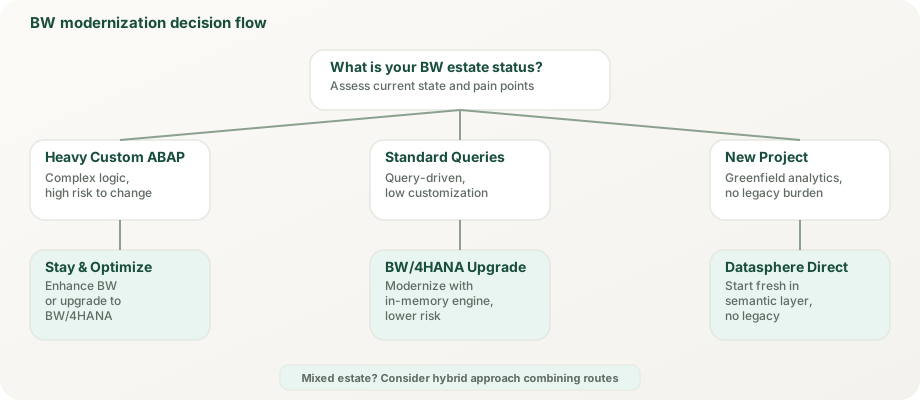
Read top to bottom: current state assessment drives trust evaluation, which informs path selection. Most organizations combine multiple paths (coexistence + greenfield pilots) rather than choosing a single route.Detailed decision flow: start with trust and constraints, then choose the speed and depth of change that the estate can realistically support.
1
Check trust first
If the current estate still carries trusted logic and stable business definitions, treat that as an architectural asset.
2
Check pain next
Modernize faster where agility, maintenance, cost, or cross-platform requirements are clearly blocked by the current shape.
3
Check ownership
Do not target a new design if no team is prepared to own semantics, controls, and operating changes in the destination model.
4
Sequence by risk
Move the pieces that create value and reduce constraint first, while protecting outputs that business users still rely on.
Query and transformation migration
What happens to BW queries and ETL logic during modernization
BW queries to Datasphere analytic models: BW queries map reasonably well to Datasphere analytic models, and SAP now automates much of the mapping: the Query Template Generator (in BDC), SAP BW/4HANA model transfer, and BW bridge model transfer all generate dimensions, fact views, and analytic models from query definitions. Dimensions and measures map cleanly; calculated and restricted key figures become analytic-model measures. What complicates translation: BEx variables with customer exits, restricted key figures that depend on ABAP logic, queries with two structures (which BW bridge model transfer cannot carry), and filter behavior that relied on BW's OLAP engine.
The practical path: Run the generators first, then triage what they could not carry. Simple queries become analytic models consumed in SAC stories; complex ones are redesigned in Datasphere, often simplifying the logic along the way. Prioritize by business criticality, not by query count.
Transformation logic migration: Start routines and simple mappings are usually rebuilt as SQL in Datasphere views or transformation flows. Expert routines, the complex ABAP that implements custom business logic, are the decision point. Option one: keep them running in BW (on BW/4HANA they can also be written as SQLScript AMDP routines, or keep BW as a private cloud edition in BDC) and consume the results as data products. Option two: carry them into SAP BW bridge, if they pass its cloud ABAP checks. Option three: rewrite them as SQL or SQLScript in Datasphere, or as a Python script operator in a data flow (faster modernization, higher immediate effort).
Process chain migration: BW process chains map to Datasphere task chains, which group tasks such as remote-table replication, data flows, transformation flows, SQLScript procedures, and nested task chains, and run them manually or on a schedule. The mapping is not one-to-one, and monitoring and restart behavior differ from BW, so test failure handling explicitly. If you keep BW in Business Data Cloud, the Data Product Generator's subscriptions run inside BW process chains, so existing orchestration carries on.
Coexistence patterns
What a realistic transition often looks like
Most environments pass through a period where BW-era logic and newer layers both matter. The point is to make the coexistence explicit, understandable, and governable.
Data sharing between layers: During coexistence, you often need data flowing in both directions. Datasphere reads BW data through its SAP ABAP-based connections (remote tables on BW InfoProviders and ODP-based extraction), through SAP BW/4HANA model transfer for released queries, and, once BW runs in Business Data Cloud, through BW data products. The key is deciding what data lives where and ensuring that the "source of truth" is clear. Usually: raw operational data in Datasphere, dimensional transforms in either system, reporting access through both BW and SAC.
Shared semantic layer strategy: Some teams implement a shared semantic glossary across BW and Datasphere—documented definitions of metrics, dimensions, and KPIs that both systems respect. This prevents "revenue means two different things in BW versus Datasphere" problems. Tools like the business glossary and KPI definitions in SAP Datasphere's catalog, or external metadata repositories, help maintain this alignment during multi-year transitions.
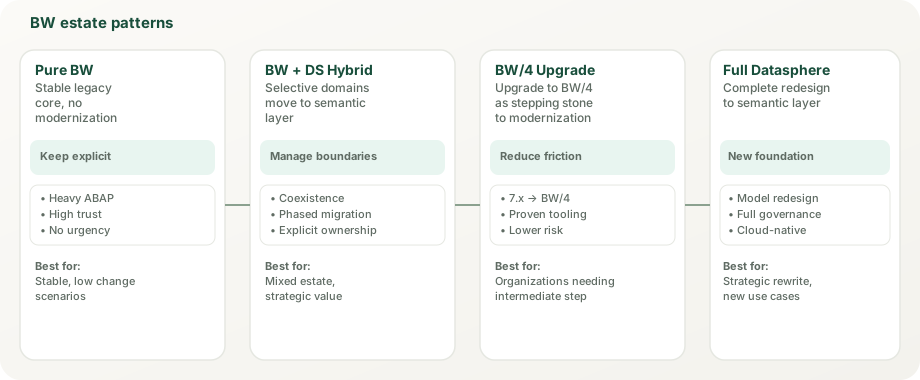
Legacy core remains trusted
Keep mission-critical definitions or reconciliations in place when immediate movement would create more risk than value.
New semantic layers emerge selectively
Introduce new semantic ownership where agility, data-product reuse, or broader analytical reuse genuinely improves outcomes.
User-facing analytics can modernize earlier
SAC and adjacent consumption choices may progress faster than deep semantic redesign, as long as trust boundaries remain clear.
Feature comparison
BW on HANA vs BW/4HANA vs Datasphere side-by-side
Understanding what each platform offers makes the choice clearer. This is not about which is "better"; it is about which capabilities matter for your specific problems.
Fewer, HANA-optimized objects (advanced DataStore objects, CompositeProviders, InfoObjects); no InfoCubes
Tables, graphical and SQL views, facts, dimensions, and analytic models
Transformations
Transformations with ABAP routines; DTPs (Data Transfer Processes)
Transformations with ABAP or SQLScript (AMDP) routines; DTPs
SQL and SQLScript views; data flows (Python script operator); transformation and replication flows
Queries & Analysis
BEx queries; OLAP engine
BW queries built in BW Modeling Tools (no BEx reporting tools); OLAP engine
Analytic models; SQL access; consumption in SAC
Scheduling
Process chains; batch
Process chains; batch
Task chains (manual or scheduled); replication flows with delta loads
Security
BW analysis authorizations
BW analysis authorizations
Spaces plus row-level data access controls (DACs)
Connectivity
SAP and non-SAP source systems, including PSA-based DataSources
Fewer source-system types (ODP for SAP sources)
Broad SAP and non-SAP connections (remote tables, replication flows, data flows); BDC Connect sharing
AI/ML Integration
Limited; external handoff
Improved; still not native
Data products shared with SAP Databricks or SAP Snowflake; Python in data flows; AI-assisted catalog content
Deployment
On-premise, or SAP BW, private cloud edition in BDC
On-premise, or private cloud edition (also in BDC); SAP HANA only
SaaS on SAP BTP; core component of SAP Business Data Cloud
Support Runway
Mainstream to Dec 2027; extended (premium) or BDC private cloud to Dec 2030; BDC Modernization Option to Dec 2033
Product line to at least 2040; per release (2023: Dec 2030)
Ongoing (SaaS model); continuous innovation
Read this table as context for your specific constraints: If your primary need is cloud operation and reuse of BW data beyond BW, the Business Data Cloud path (BW private cloud edition plus data products, with Datasphere for new modeling) is the natural fit. If you need to preserve ABAP logic for years while modernizing around it, BW/4HANA, on premise or as a private cloud edition, is more pragmatic. If your current estate is stable and change is not urgent, staying on BW 7.5 through 2030 is defensible, as long as the exit is planned. The table shows capability, not destiny.
Private cloud editions and Business Data Cloud
Cloud deployment options and their relationship to modernization
SAP offers BW as private cloud editions, SAP BW, private cloud edition (BW 7.5) and SAP BW/4HANA, private cloud edition, including inside SAP Business Data Cloud. This is an operational choice, not a strategic escape from modernization: teams get SAP-managed operations without adopting new semantics immediately. Inside BDC it is also the prerequisite for the Data Product Generator and Query Template Generator, and it covers BW 7.5 to the end of 2030. A private cloud edition can also suit organizations with regulatory or data-residency requirements that rule out multitenant services.
SAP's own learning material describes the sequence in three steps: first optimize and lift the BW system into a private cloud edition in Business Data Cloud; then modernize with the Data Product Generator and Query Template Generator; then innovate by sharing BW data products with SAP Databricks and SAP Snowflake and by rethinking use cases around SAP-managed data products. SAP's stated long-run option is to replicate the remaining BW data into BDC and decouple BW, which shifts the discussion from "should we modernize?" to "at what pace and in what sequence?"
Target-state routes
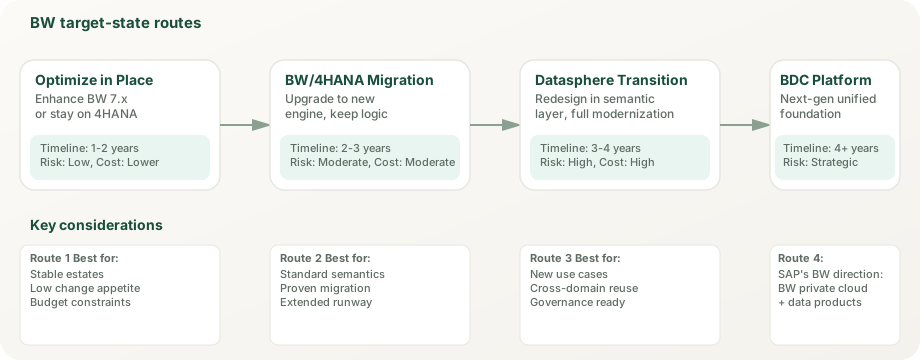
Where modernization can lead
There is no single target state for every SAP analytics estate. The right route depends on what the business needs from semantics, analytics experience, integration, and governance.
Different estates justify different destinations: the quality of the route matters as much as the ambition of the destination.
Retained-core route
Keep BW or BW/4HANA central for longer when trust, stability, and existing ownership still outweigh the benefits of deep redesign.
Staged coexistence route
Modernize one domain, semantic slice, or analytics use case at a time while the existing estate continues to serve critical needs.
Semantic redesign route
Move toward newer semantic structures when business meaning must be more reusable, cross-domain, or adaptable than the current estate allows.
Broader strategic transition
Shift more aggressively only when business pressure, platform direction, and operating readiness all point the same way.
Modernization assessment framework
How to evaluate your BW landscape and readiness
Object inventory: Start by counting. How many InfoProviders (dimensions, fact tables, CompositeProviders)? How many queries? How many transformations? How many process chains? Large estates (500+ InfoProviders, 2000+ queries) will take longer to modernize than small ones. This is not judgment; it is just scale.
ABAP complexity score: Audit your transformations for ABAP content. What percentage are pure start routines (easier to convert to SQL)? What percentage are expert routines (harder to convert, often require redesign)? What percentage reference customer-specific tables or ABAP APIs? High ABAP complexity means you cannot fully automate migration; you need skilled ABAP developers to participate in redesign.
Data volume analysis: How much data flows through your BW system daily? How many years of history? Large data volumes (multi-TB) mean migration is slower and more careful. Small data volumes (sub-TB) can often be reloaded from source during migration.
Business criticality mapping: Not all analytics are equally important. Audit your reports by stakeholder impact: which reports must never go down? Which can tolerate a brief outage during migration? Which are rarely used and could be retired? This informs your migration sequencing.
Tools for assessment: SAP Readiness Check for SAP BW/4HANA and SAP Datasphere, SAP BW bridge (SAP Note 2575059) assesses a BW system for conversion, and the BW sizing report (SAP Note 2296290) estimates the target size, including for the bridge. Partner assessment tools can go deeper into transformation logic. A few weeks of structured assessment before committing to a modernization program is usually time well spent.
Total cost of ownership
Legacy BW versus cloud modernization: the real financial picture
Legacy BW TCO (annual): Hardware and infrastructure (on-premise or cloud IaaS), HANA database licensing (significant), SAP basis team costs (system administration, patching, backup), ABAP developer costs (maintaining transformations and routines), plus indirect costs of technical debt and slow analytics innovation.
Datasphere / cloud TCO (annual): Business Data Cloud capacity units (new Datasphere and SAC licenses go through BDC core capacity), cloud infrastructure (included in SaaS), SAP support for SaaS, reduced basis team overhead (cloud infrastructure is managed), potentially more self-service analytics ownership, but higher initial modernization costs (migration effort, redesign, training).
The shape of the curve: Whether modernization lowers total cost depends on the starting estate and on decommissioning discipline; there is no reliable industry benchmark to borrow. The first years usually cost more (dual maintenance, migration effort, new training), and any payoff arrives only as legacy operations are actually switched off. Teams that leave legacy BW running "just in case" rarely realize the savings they modeled.
Hidden costs often underestimated: Data validation during migration (ensuring Datasphere reports match BW reports exactly). Training (analysts learning new tools, consultants learning new patterns). Parallel running (maintaining both systems simultaneously for 1-2 years). Unplanned refinement (discovered logic gaps during migration that require rework). Teams that budget for these typically execute modernization more smoothly than teams that treat them as optional.
The human side of modernization
Re-skilling BW teams and rebuilding analytics leadership
Career paths for BW developers: A BW Developer does not become obsolete during modernization; they become a Datasphere Architect or Data Integration Engineer. The core skills—dimensional thinking, business domain knowledge, transformation logic design, governance discipline—remain valuable. What changes is the syntax and tools. Experienced BW developers can make the transition with focused learning and real project work. The challenge is often emotional, not technical: validating the investment they made in BW expertise while asking them to learn new patterns.
What skills transfer directly: Data modeling logic (dimensions, measures, hierarchies work differently in Datasphere but the concepts are similar). Business domain knowledge (the analyst who knows all the nuances of supply chain metrics keeps that knowledge). Governance and control discipline (the person who maintains data quality processes can maintain them in a new system). Query and reporting thinking (dimensional analysis translates across platforms).
What skills are new: Cloud-native thinking (scaling, elasticity, multi-tenancy). SQL fluency (Datasphere requires SQL for most advanced work; BW developers often relied on graphical UIs). API-first design (Datasphere integrates through APIs more than BW did). Self-service semantics (Datasphere supports more self-service modeling than BW; teams need to organize around that capability).
How to execute the transition well: Do not wait until migration starts to begin training. Run pilot projects with small teams 6-12 months before major migration phases. Pair BW experts with Datasphere mentors on actual work, not just classroom training. Celebrate migration successes and expertise contributions publicly. Create clear career ladders so people see advancement opportunity in the new environment. Organizations that treat re-skilling as a development opportunity, not a cost center, retain more institutional knowledge through the transition.
Boundaries and limitations
What modernization is not
Modernization gets confused with other types of work. These boundaries clarify what it actually is and what it should not be asked to solve alone.
Modernization is not mandatory
BW and BW/4HANA estates that are stable, well-governed, and meeting business needs do not have to modernize. The fact that newer tools exist does not mean every legacy system must disappear. Valid reasons to stay include low change velocity, proven reliability, and unclear ROI from migration.
Modernization is not a single path
There is no one "right" target state. Coexistence, staged transition, semantic redesign, and full migration are all legitimate routes. The architecture should fit the business need and organizational readiness, not conform to a template.
Modernization is not just a technical lift
Replacing the tool is the smallest part. Real modernization includes semantic redesign, ownership change, governance evolution, and operator readiness. Technical migration without those is incomplete modernization.
Modernization is not a platform-speed problem
When teams say "we need to modernize faster," the real issue is often unclear dependencies, weak ownership, or unresolved business disagreements—not the speed of the tool itself.
Modernization is not a shortcut to semantic clarity
Moving from BW to Datasphere does not automatically fix poorly defined metrics or fragmented business meaning. Modernization gives you a cleaner place to define meaning, but the definition work still has to happen.
Modernization is not an excuse to erase operating knowledge
BW and BW/4HANA carry years of operating discipline, known dependencies, and proven patterns. Treating all that as obsolete just because the technology is older creates unnecessary risk in the transition.
Common mistakes
What makes modernization harder than it needs to be
Most modernization pain comes from weak framing, not from the existence of legacy alone. When teams get these wrong, they create urgency without clarity.
Replacement mythology
Declaring that everything old must disappear quickly usually hides the real work of dependency analysis, trust preservation, and ownership transfer. The mental image of "rip and replace" is simpler than the actual work of moving a live system with years of business logic built on it.
Invisible coexistence
Letting old and new layers overlap without explicit rules produces semantic drift, reporting confusion, and governance gaps. Teams often discover too late that they have built two semantic layers instead of managing a transition between them.
Destination without operators
A target architecture is not credible if no team is ready to own the semantic model, controls, lifecycle, and support model in that destination. Vision without operating readiness is just a nice slide deck.
Orientation by audience
How to read modernization from beginner to expert
Different readers need different lenses, but all of them should leave with a realistic view of timing, coexistence, and trust.
Beginner
Understand that modernization is usually a staged transition, not an instant replacement.
Practitioner
Focus on dependency mapping, reporting continuity, semantic responsibility, and controlled cutover timing.
Architect
Clarify which layers should stay, which should coexist, and which should become the future semantic or experience layer.
Executive
Judge modernization by business continuity, future flexibility, and reduced architectural friction rather than by novelty alone.
Current SAP frame
What matters in the current SAP material
Current SAP learning and help content treats BW modernization as a portfolio decision, not a slogan. That is useful because it keeps deployment options, BW bridge, and staged transition patterns visible while teams decide how fast to move.
BW still represents working enterprise logic
Current BW/4HANA learning paths still teach the core warehousing model because many estates rely on it for trusted historical logic, acquisition, virtualization, and reporting continuity.
BW bridge keeps coexistence real
SAP Datasphere, SAP BW bridge exists because many modernization programs need familiar BW staging objects and methods to remain available during a transition instead of disappearing overnight. Shell conversion moves the metadata, remote conversion also transfers the data. SAP says the bridge is still supported, while calling SAP BW, private cloud edition in Business Data Cloud the strategic route for BW customers.
Data Product Generator accelerates migration
The Data Product Generator (available since 2025, running in SAP BW, private cloud edition in BDC) replicates BW InfoProvider data, with semantics and associations, into the Datasphere object store as data products, and the Query Template Generator carries BW queries into Datasphere analytic models. Transformation logic still has to be redesigned by hand.
Layer separation still matters
Modernization gets cleaner when BW continuity, Datasphere semantics, SAC consumption, and Business Data Cloud direction are treated as related but distinct decisions.
Official SAP reference routes
Use SAP learning and help content before turning modernization into a program
These are the most useful SAP sources for understanding the current modernization frame, what BW still does today, and how SAP is positioning bridge and transition patterns.
How organizations use BW Modernization in practice
BW modernization creates value when it maintains trusted reporting while introducing flexibility and newer analytics patterns. These illustrative scenarios show typical ways organizations transition legacy BW logic to newer foundations.
Manufacturing
Phased BW to Datasphere Migration
A manufacturer had 20 years of BW logic and reporting dependencies. A rip-and-replace approach was too risky, but staying on BW limited agility and clouded the analytics direction.
Phased migration: SAP BW bridge carried the proven staging flows, queries were transferred into Datasphere analytic models, and new semantics were modeled in Datasphere. Old reports stayed stable while new use cases emerged faster, without business disruption.
Financial Services
BPC to SAC Planning
A financial institution was using BPC for planning but wanted tighter integration with live actuals, faster planning cycles, and newer analytics tools. BPC was becoming a maintenance burden.
Migrated planning logic to SAC planning while keeping BPC running in parallel for a defined period, then decommissioned BPC once the planning cycles had run cleanly in SAC.
Cross-industry
BW Query Optimization
A company had BW queries that had become too slow for daily use. The data volumes had grown but the query design was from an earlier era. Query optimization was at its limits.
Redesigned the data model and queries with current modeling and aggregation options; run times returned to interactive levels, which showed the value of modernization without migration.